AgentOS
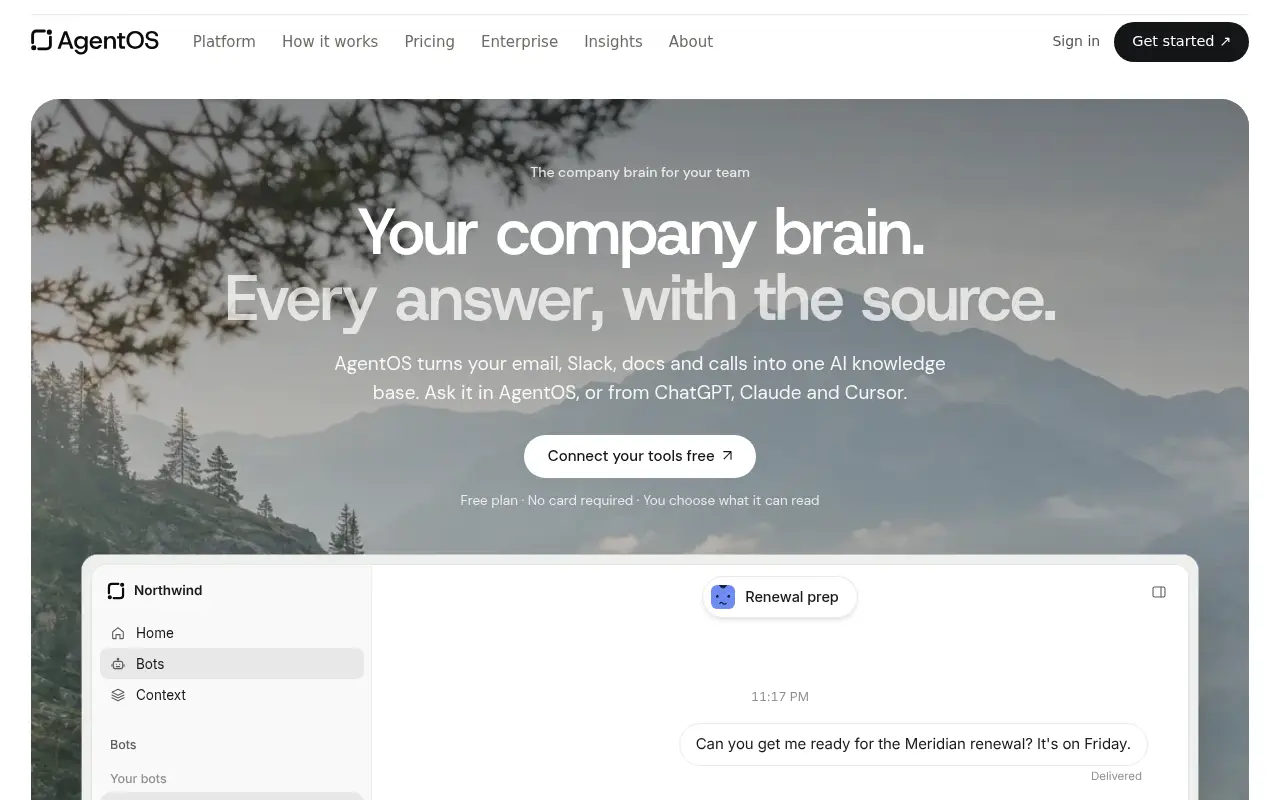
AgentOS connects a team's email, Slack, docs and calls into one searchable memory that Claude, ChatGPT, Cursor and custom agents can all read.

Project links
Visit productRequest correctionProject Note
A closer look at AgentOS
Connects a team's email, Slack, docs and calls into one memory that its AI tools share over MCP.
One memory for the AI tools your team already uses
If your sales lead works in Claude, your engineers live in Cursor and marketing uses ChatGPT, none of those tools know what the others did or what a client was promised on Tuesday's call. Everyone ends up re-explaining the same background to a different assistant.
AgentOS, from a small AI consulting company called Devcore, tries to fix that. You connect the places work already happens, such as Gmail, Slack, Google Drive and Google Calendar, plus GitHub and meeting recorders, and it builds a searchable knowledge base from them. You can ask questions inside AgentOS, or connect Claude, ChatGPT, Cursor and custom agents over MCP so they read the same context.
The useful detail is that answers point back to their sources. The site's example asks what a client was promised on pricing and shows the email and call behind the reply. One thing to know when you go looking: several unrelated products use the AgentOS name, and the company says so itself. This one lives at tryagentos.net.
Otto, skills and who gets to do what
A built-in manager agent called Otto keeps records current, chases follow-ups and messages people when something needs a decision. Skills are written procedures, such as a client prep brief, that every connected agent then follows the same way. Bots are agents that wake up on their own for recurring work.
You choose what each agent can reach, so Slack might be read and draft while a finance folder stays off limits. The company says consequential writes to business systems wait for human approval, and its privacy policy says email goes out only after you approve it. Slack is looser, since AgentOS can post replies in channels you grant. The terms also warn that AI output can be wrong and that you're responsible for how it's used.
Before you connect an inbox
You can start without paying. The free plan has 200 credits a month, 300 extra at signup and 100 workflow runs a month, with no card required. Starter is $20 a month for 1,000 credits, Pro is $99 for 6,000, and Team is $299 for three people sharing 20,000 credits, with each extra person at $79. Yearly billing gives two months free. Monthly credits don't roll over, and $10 buys 500 credits that never expire. Credits cover model usage and vary by model and task, so it's hard to know from the pricing page how far a plan will go.
The privacy policy, effective October 29, 2026, names its providers one by one, and it's worth reading because this product takes in a lot. Workspace content and connected-app data stay for as long as your workspace exists. To answer requests, AgentOS sends content mostly through OpenRouter to model providers such as OpenAI, Anthropic and Google, along with Moonshot AI, DeepSeek and Z.ai. Devcore says it doesn't train models on your content, though some providers keep request data briefly to monitor abuse.
Composio holds the access tokens for Gmail and Drive, and Recall.ai captures audio, video and transcripts when you send the recorder to a meeting. In the app, PostHog records session replays with typing and workspace text masked. Sign-up and payment events go to OpenAI Ads with a hashed email address. Deleting a workspace means writing to Devcore by email.
A team with client confidentiality duties should go through that list before connecting anything. If the list sits fine with you and your team's context is scattered across three assistants, the free plan is a low-stakes way to see what a shared memory feels like.
For reference
Project facts
The published details and source context, together in one place.
- Public Context Check
- Public pages were checked Nov 10, 2026.
Project note details
Dates and editorial links
Published
November 10, 2026
Updated
November 12, 2026
Note history
Publication and substantive update dates for this public note.
- Nov 10, 2026
- Project note published.
- Nov 12, 2026
- Project note updated.
- Nov 10, 2026
- Public-page information added to the note.
Want to come back to AgentOS?
Save it to this browser. Your Saved list marks projects whose note or updates changed since you last looked.
Keep exploring
More like AgentOS
- LarkgrassAI & Skills · An agent platform pitched at people who aren't technical.
- TaleAI & Skills · A shared project workspace for task planning, agent delegation and review of reports and files.
- AgentMatterDeveloper Tools · A bilingual directory of public GitHub resources for AI agents, with repository, ownership, license, and installation context.
- Raydo Agent OSAI & Skills · Raydo Agent OS is a desktop app for running AI agents on real tasks.
- AI diagram agentAI & Skills · A browser diagram workspace with text and file input, chat revisions, manual editing, saved versions and PNG, SVG or PDF exports.
- VecbaseAI & Skills · Vecbase lets teams assign work to AI agents, share files and skills, schedule tasks, and watch tool activity in one workspace.
- EchobellDeveloper Tools · Echobell turns a webhook or an email into a phone alert, including a call that rings when a server goes down.
- DugoutSaaS · A team workspace where AI agents sit in the same channels, boards and docs as people, with free chat, huddles and kanban, and agents from $4 a member.







For the makerAdd the badge to your site
If you made AgentOS, you can post about this note with a ready-to-edit announcement, or show it on your own site with an optional badge that links back here. Neither has any effect on the note or its placement.

Want to keep this note's facts current yourself? Project Radar Pro lets a verified maker confirm status, pricing and platforms in a labeled block, post one update a month and see the note's activity totals. It never changes the note's text or placement. See what Pro includes
Building something useful?
Submit your project for free. If selected, it gets a Project Note that explains what it does and links to your work. Publication isn't guaranteed.
Submit a project