ReactionTest
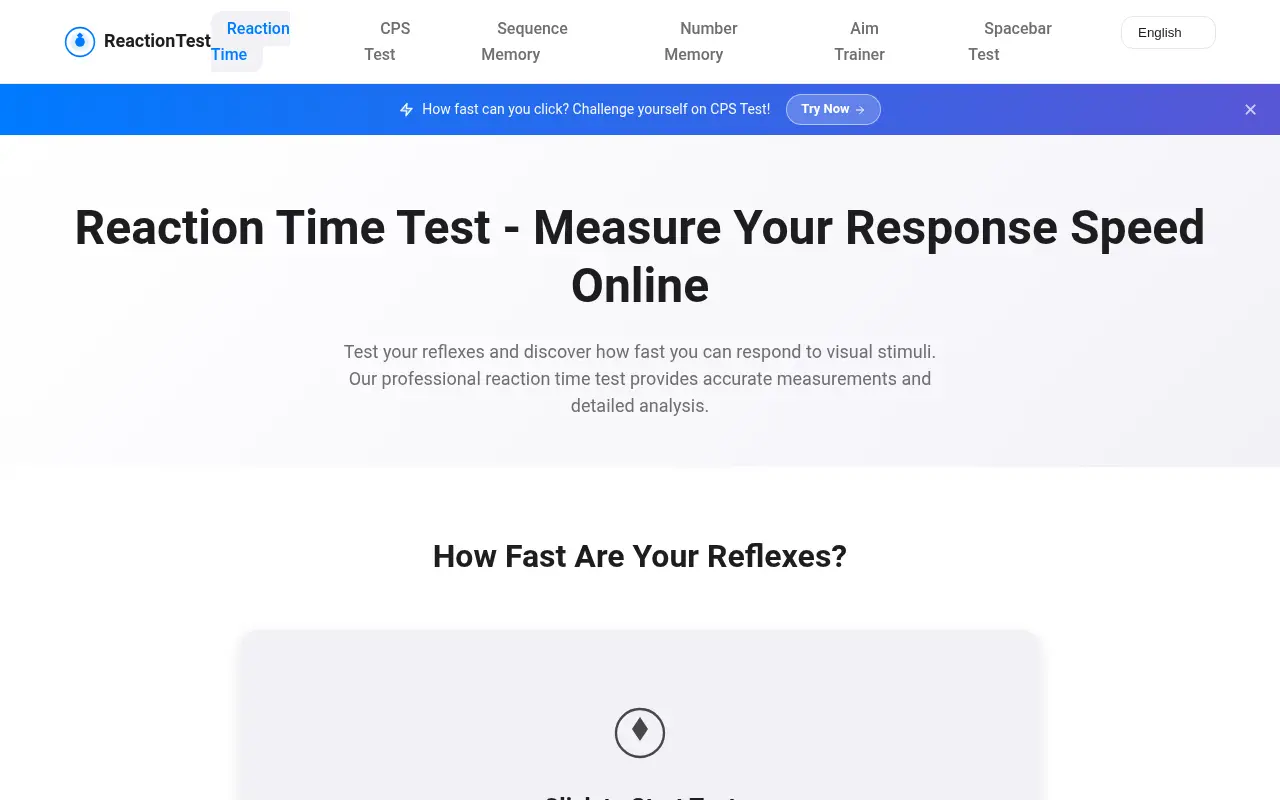
A free browser reaction-time test. Wait for the screen to turn green, click, and get your average over five rounds, alongside click-speed, memory and aim tests.
 R
Project links
Visit productRequest correctionProject Note
A closer look at ReactionTest
A free five-round visual reaction-time test in the browser, with no account or download. It's a casual challenge, not a medical assessment.
Wait for green
Sooner or later somebody claims to have the quickest reflexes in the room, and you need a way to settle it. ReactionTest is a free browser test for that sort of thing, with no account or download. You press start, wait for the background to turn green, and click or tap as soon as it does. It runs five rounds and then shows your best time and your average in milliseconds.
The site explains the five rounds plainly. The first try is often slow because it catches you off guard, so an average of several attempts says more than any single click.
Below the test there's a small reference table of typical visual reaction times by age, roughly 190 to 250 ms for people aged 18 to 30 and 250 to 350 ms for people over 50. That gives a result some context without turning it into a diagnosis. The project calls it a casual challenge rather than a medical assessment, which is the right way to read it.
More ways to test yourself
The same site has a click-speed test with timers from 1 to 120 seconds and a spacebar test. Sequence Memory, Number Memory and an Aim Trainer round things out. They're all short, browser-based drills, handy for warming up before a game or settling an argument about who's quicker. The interface comes in ten languages.
Hardware matters more than the site can control. Its FAQ says the test accounts for display lag and input delay, but that results still vary with your device, browser and connection. Compare scores taken on the same setup.
A little fine print
There's no sign-up. The privacy policy, dated December 2024, says test results and settings stay in your browser's local storage, lists IP address and browser details among the technical data it collects, and names Google Analytics. The home page also loads Google's ad script, which the policy doesn't mention.
Neither the policy nor the terms name a person or company behind the site, only contact addresses at the domain. If you fancy a friendly contest over who's quicker, it's a fun one to pass around.
For reference
Project facts
The published details and source context, together in one place.
- Public Context Check
- Public pages were checked Nov 9, 2026.
Project note details
Dates and editorial links
Published
November 9, 2026
Updated
November 12, 2026
Note history
Publication and substantive update dates for this public note.
- Nov 9, 2026
- Project note published.
- Nov 12, 2026
- Project note updated.
- Nov 9, 2026
- Public-page information added to the note.
Want to come back to ReactionTest?
Save it to this browser. Your Saved list marks projects whose note or updates changed since you last looked.
Keep exploring
More like ReactionTest
- PhantomBiteGames & Fun · PhantomBite calls itself a free parody food delivery game.
- CPS TestGames & Fun · A free click speed test for mouse, trackpad or touchscreen.
- TestMyReading – Track pace then mark a short quizEducation Tools · A free reading speed test that pairs your words-per-minute score with a short comprehension quiz, plus a Chrome extension in beta.
- Typing Speed Test by CleverHumanizerEducation Tools · Typing Speed Test by CleverHumanizer is a free WPM test that runs in your browser.
- ReactionMetricGames & Fun · ReactionMetric is a free reaction time test you run in the browser.
- Best Reaction TestGames & Fun · Best Reaction Test is a free online reaction time test.
- InternetSpeedGeoUtilities & Calculators · InternetSpeedGeo is a free browser speed test for download, upload and ping, with no account.
- SumivoUtilities & Calculators · 48 free calculators for batteries, circuits, OEE, takt time, fractions and more, each with its method and test runs shown.







For the makerAdd the badge to your site
If you made ReactionTest, you can post about this note with a ready-to-edit announcement, or show it on your own site with an optional badge that links back here. Neither has any effect on the note or its placement.

Want to keep this note's facts current yourself? Project Radar Pro lets a verified maker confirm status, pricing and platforms in a labeled block, post one update a month and see the note's activity totals. It never changes the note's text or placement. See what Pro includes
Building something useful?
Submit your project for free. If selected, it gets a Project Note that explains what it does and links to your work. Publication isn't guaranteed.
Submit a project